

Table of Contents
- Why Great Lakes Legends Still Matter
- Great Lakes Shipwreck Mysteries That Haunt the Region
- Great Lakes Monster Sightings: From Bessie to the Leviathan
- Sleeping Bear Dunes Legends: The Mother Bear and Her Cubs
- How Geography Shapes Great Lakes Folklore
- The Historical Roots of the Term 'Legends'
- Mapping the Legends: Sites You Can Visit
- Frequently Asked Questions
Last Updated: September 10, 2026
Why Great Lakes Legends Still Matter
Great Lakes legends are the folk stories, ghost ships, monster sightings, and origin tales that have circulated around the five inland seas for generations, and they remain one of the most enduring ways people connect with the region. This guide from Northern Michigan Fanatics Club covers the shipwrecks, creatures, and dune stories that still shape how residents and visitors talk about the water.
Here's the part most roundups miss: these stories aren't random. They cluster around specific geography, which is why the same stretch of shoreline keeps producing new versions of the same tale. Below, we'll walk through the shipwreck mysteries, monster sightings, and dune legends that define the region, plus where you can actually visit the sites.
The stories survive because they're retold in kitchens, on docks, and around campfires every summer. That oral tradition is the real engine behind Great Lakes legends.
Great Lakes Shipwreck Mysteries That Haunt the Region
Great Lakes shipwreck mysteries endure because the lakes are unforgiving and the records are genuinely incomplete. Thousands of vessels have gone down across the lakes, and many were never found, which leaves room for stories to grow.
The Wreck That Vanished Without a Trace
The most famous vanishing act involves a large ore carrier that left port with a full crew and simply never arrived. No distress call. No wreckage found at the time. Searches turned up nothing for years.
What keeps this story alive isn't the disappearance itself, it's the total absence of explanation. A ship that size doesn't just evaporate. Storms on the lakes can build fast and hit hard, but even then, debris usually surfaces. The lack of it is what fuels the retellings.
Ghost Ships and Haunted Waters
Ghost ship sightings follow a predictable pattern. A vessel appears in fog, sails silently against the wind, and disappears when approached. Sailors have reported these sightings for well over a century.
The stories persist because the lakes genuinely produce strange visual conditions. Temperature inversions and heavy fog banks can make distant ships appear to float or move oddly (noaa.gov). That doesn't explain every account, but it explains enough to keep the legend fed.
Great Lakes Monster Sightings: From Bessie to the Leviathan
Great Lakes monster sightings describe reported encounters with large, unidentified creatures in the lakes. The most famous is a serpent-like animal nicknamed Bessie, reported for well over a century in the western basin of Lake Erie near Toledo and the Bass Islands. But Bessie is not the only one, the region has a whole cast of named creatures, and each one is tied to a specific stretch of water.
The Named Creatures of the Inland Seas
- Bessie (Lake Erie): A long, dark, serpentine animal, usually described as 20 to 40 feet with a series of humps. Sightings cluster around the western basin and the islands, and reports have been logged since the 1800s. Witnesses are often experienced boaters and anglers.
- South Bay Bessie (Lake Erie, New York shore): A regional variant of the same name, reported near the eastern end of the lake. The two names are sometimes used interchangeably, which is part of why the legend feels bigger than one lake.
- The Lake Michigan serpent: Reports of a large, eel-like creature off the Wisconsin and Michigan shores, often described at dusk when the surface is glassy.
- The Lake Superior "leviathan": A catch-all label for oversized, unidentified shapes reported by mariners, frequently attributed to giant sturgeon or logs.
What Actually Produces a Sighting
Most reports describe a long, dark shape breaking the surface in a series of humps, moving faster than a boat. The practical explanations are well understood:
- Lake sturgeon. These fish can exceed 6 feet and live for decades. When they roll or breach at dusk, the segmented back reads as humps. A sturgeon breaking water at 30 yards can absolutely look like a sea monster if you are not expecting it.
- Gar and muskellunge. Long, torpedo-shaped fish that surface briefly and leave a wake that looks serpentine.
- Temperature inversions and mirage effects. Cold water under warm air bends light, stretching a distant log, bird, or boat into an elongated shape.
- Floating debris and gas releases. Decomposing vegetation on the bottom can release gas that lifts mats of material to the surface, creating a moving, humped silhouette.
That does not explain every account, but it explains enough to keep the legend fed, and the unexplained remainder is what keeps it alive.
How to Read a Sighting Report
When you look at a reported sighting, check three things: the time of day, the wind direction, and the water temperature. Most credible reports happen in calm, low-light conditions with a temperature inversion, which is exactly when optical distortion is strongest. That pattern is not proof of a monster, but it is a useful filter for separating a genuine anomaly from a trick of the light.
Sleeping Bear Dunes Legends: The Mother Bear and Her Cubs
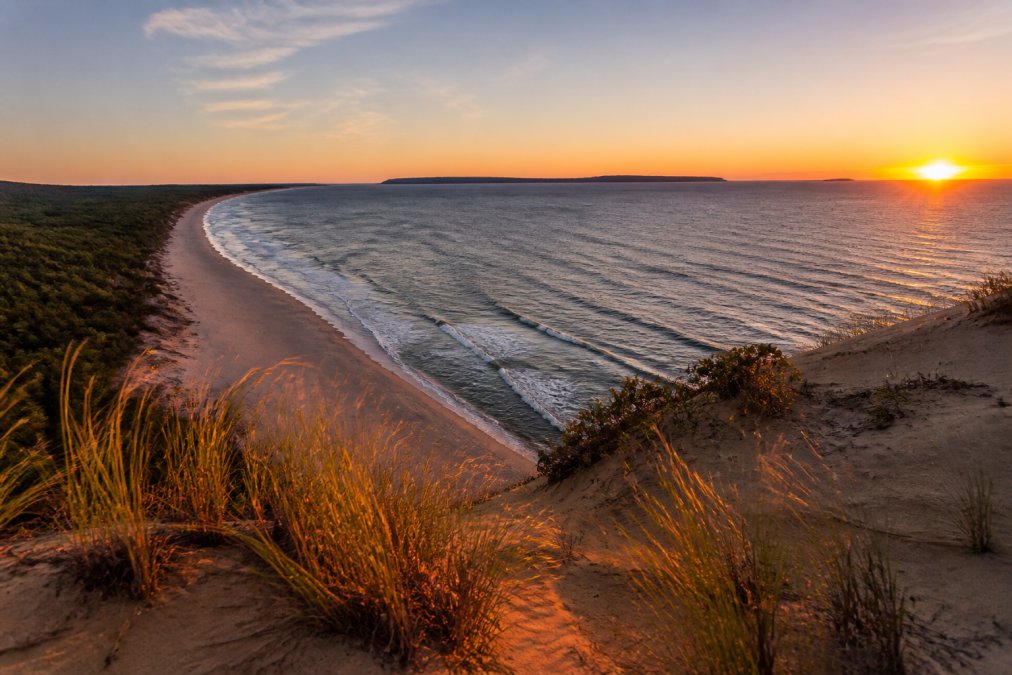
Sleeping Bear Dunes legends center on an Ojibwe story of a mother bear and her two cubs that swam across Lake Michigan to escape a forest fire. The mother reached the shore and waited on the bluff for her cubs, who never arrived, and she remains there today.
The Ojibwe Story Behind the Dunes
The two islands visible offshore are said to be the cubs, transformed into land. The great sand bluff is the mother, still watching. It's one of the few origin stories in the region with a direct, visible landmark tied to it.
That visibility is why the story has lasted. You can stand on the dune and see the islands the story describes, which makes it feel less like folklore and more like geography with a memory.
How Geography Shapes Great Lakes Folklore
Geography drives these stories more than anything else. The lakes are vast enough to hide things, shallow enough in places to strand wrecks, and prone to sudden weather that turns calm water violent within an hour.
That combination produces two kinds of tales: disappearances and sightings. Both depend on the same thing, an environment where you can't see what's under you and can't always predict what's coming. Folklore fills the gaps that maps and forecasts leave open.
The National Oceanic and Atmospheric Administration's Great Lakes environmental data documents how quickly conditions shift on these waters, which explains why so many legends start with a sudden storm.
The Historical Roots of the Term 'Legends'
The word "legend" originally referred to stories about saints read aloud in religious services, then broadened to mean any widely told story with a kernel of historical truth (merriam-webster.com). That second meaning is what applies here. But there is a more interesting question that almost no roundup answers: why does the word "Legends" show up across so many unrelated industries in this region, racing, flooring, sports, and folklore?
Why One Word Covers So Many Things
The answer is that "legend" is a marketing and cultural shorthand for three different ideas, and the region happens to use all three at once:
- A story with a real anchor. A legend claims something happened at a specific place to specific people. That is why the Mother Bear story is a legend and not a fairy tale, you can stand on the dune and see the islands.
- A person or team with a long record. In racing and sports, "legend" means someone whose career outlasted the normal window, a driver or player whose name is still repeated decades later. The word signals longevity, not magic.
- A product line with a heritage claim. In flooring and building products, "legend" is used to signal durability and a long track record. It is a brand word, not a folk word.
The Regional Overlap
The overlap is not an accident. The region has a strong oral tradition, a long history of local racing circuits and amateur sports, and a manufacturing base that has spent a century building things meant to last. All three feed the same word. When a search engine sees "great lakes legends," it cannot tell which of the three you mean, which is exactly why the results are fragmented between flooring products, race schedules, and ghost stories.
How to Tell Which "Legend" You Are Looking At
- If the page has a schedule, a venue, and a ticket price, it is the racing or sports meaning.
- If the page has a plank thickness, a wear layer, and a warranty, it is the flooring meaning.
- If the page has a date, a location, and a witness account, it is the folklore meaning.
That distinction matters because the three categories have almost nothing else in common. A person searching for a race schedule does not want a ghost story, and a person searching for a ghost story does not want a flooring spec sheet. The word is the only thing they share.
Mapping the Legends: Sites You Can Visit
Many of these stories are tied to places you can actually stand in. The dunes overlook is the most obvious, but shipwreck sites, lighthouses, and coastal towns all carry their own versions of the tales.
Here's a quick reference for matching legend to location:
| Legend | Location Type | Best Time to Visit | What to Look For |
|---|---|---|---|
| Mother Bear and Cubs | Sand dune overlook | Late afternoon | Islands on the horizon |
| Ghost ship sightings | Open water, fog-prone | Early morning | Fog banks off the point |
| Monster sightings | Shallow western basin | Calm evenings | Surface disturbance |
| Vanished wreck | Historic port towns | Summer | Local archive displays |
A common mistake is treating these as pure entertainment. The sites themselves are the draw, and the stories are how people remember which shoreline matters.
If you want to carry a piece of that culture with you, Northern Michigan Fanatics Club offers apparel and drinkware inspired by the lakes, small towns, and landmarks these stories come from. Members get access to exclusive discounts, member-only giveaways, and a shot at winning a Northern Michigan vacation.
The stories only survive if people keep telling them, and that means keeping the places and traditions they belong to alive. Northern Michigan Fanatics Club exists for exactly that: a community built around the lakes, the small towns, and the memories that make this region worth returning to. With themed apparel, tumblers, and mugs, plus VIP membership perks like exclusive discounts and giveaways, it's a way to wear the region you love. Get started with Northern Michigan Fanatics Club and carry a piece of the lakes wherever you go.
Frequently Asked Questions
What are some common myths associated with the Great Lakes?
Common myths include the underwater panther, giant serpents, and ghost ships. Many stem from Native American oral traditions and shipwreck survival stories. The Great Lakes' unpredictable weather and deep waters have fueled tales of mysterious creatures and haunted wrecks for centuries.
What is the most famous monster legend in the Great Lakes?
The most famous is Bessie, a serpent-like creature reportedly spotted in Lake Erie since the 1800s. Descriptions vary from a giant eel to a prehistoric reptile. Despite numerous sightings, no scientific evidence has confirmed its existence, but the legend persists in local folklore.
Are there ghost stories associated with Great Lakes shipwrecks?
Yes, many shipwrecks have ghost stories. The SS Edmund Fitzgerald, which sank in 1975, is often linked to supernatural tales. Sailors have reported phantom ships and eerie lights near wreck sites. These stories reflect the region's maritime history and the dangers of the lakes.
How do Great Lakes legends reflect the history of the region?
Legends often mirror real events like shipwrecks, storms, and cultural clashes. They preserve Native American traditions and immigrant narratives. By studying these tales, we gain insight into the fears, values, and experiences of those who lived along the lakes.